The Blue Pioneer: How "Stanley" Won the Desert and Changed the Future
In 2005, a blue Volkswagen Touareg named Stanley made history by winning the DARPA Grand Challenge, navigating 132 miles of rugged Mojave Desert terrain without a single human intervention. Developed by the Stanford Racing Team, Stanley wasn't just a car with a GPS; it was a pioneer of machine learning, using a sophisticated array of LIDAR, radar, and cameras to "see" and adapt to the environment in real-time.
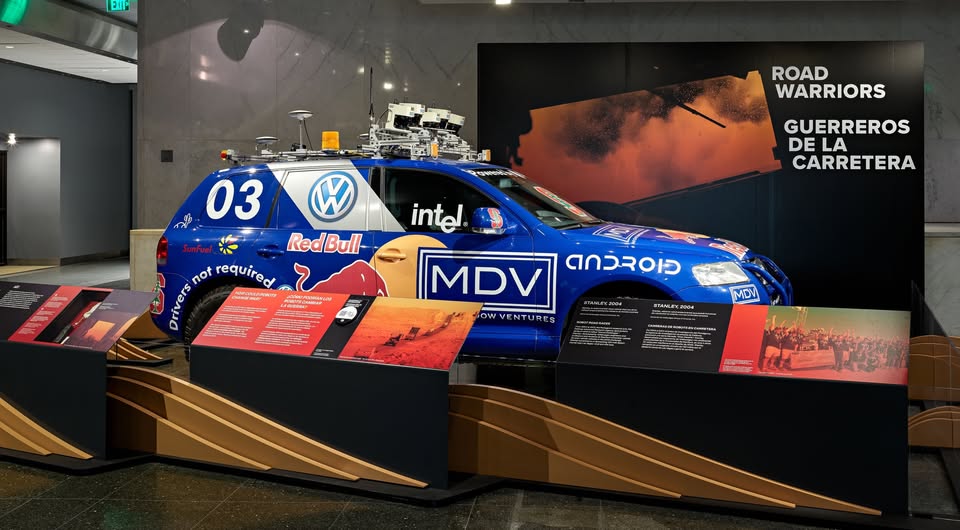
During my visit to the National Museum of American History in Washington, D.C. last month, I found myself standing in front of a rugged, mud-splattered blue Volkswagen Touareg. At first glance, it looked like a typical off-road vehicle, but the array of sensors, lasers, and rooftop equipment told a different story.
I didn’t take a guided tour, so I was left to explore the exhibits on my own. When I leaned in to read the plaque and saw that this machine—Stanley—had successfully driven itself across the desert back in 2005, I was genuinely shocked. In an era where we are still debating the safety of self-driving cars, it was hard to believe that such a feat was accomplished nearly two decades ago. This sparked a deep curiosity in me, leading me to research the incredible story behind this robotic pioneer.
The DARPA Grand Challenge
To understand Stanley, you have to understand the DARPA Grand Challenge. In 2004, the U.S. government’s defense research agency (DARPA) held a race for autonomous vehicles in the Mojave Desert. The result was a disaster: not a single car finished the course. Most crashed or got stuck within miles of the starting line.
Determined to prove it could be done, DARPA held a second challenge in 2005. This time, a team from Stanford University, led by Sebastian Thrun, entered a modified Volkswagen named "Stanley."
What Made Stanley Different?
While other teams relied on rigid, pre-programmed maps, the Stanford team gave Stanley a "brain." Using a combination of LIDAR (laser sensors), radar, and cameras, Stanley used machine learning to "see" the road and decide how to navigate obstacles in real-time. It didn't just follow a path; it learned to drive.
On October 8, 2005, Stanley completed the 132-mile desert course in just under seven hours, with no human intervention, claiming the $2 million prize and a place in history.
From the Desert to the Smithsonian
Stanley is now a permanent resident at the Smithsonian because it represents the "Kitty Hawk moment" for autonomous driving. The technology developed for this blue SUV eventually led to the creation of Google Street View and Waymo, fundamentally changing how we think about transportation.
A Different Perspective on History
My visit to see Stanley was a reminder of how individual visionaries can shape a nation's cultural landscape. This experience also made me reflect on the broader differences between the museum cultures of the Old World and the New World. If you're curious about how the American approach to preserving history differs from the European tradition, I’ve shared some further thoughts in my other article:
Read more: Why Washington D.C.’s National Museum of American History Hits Differently Than European Museums
Author: Recep Zerk